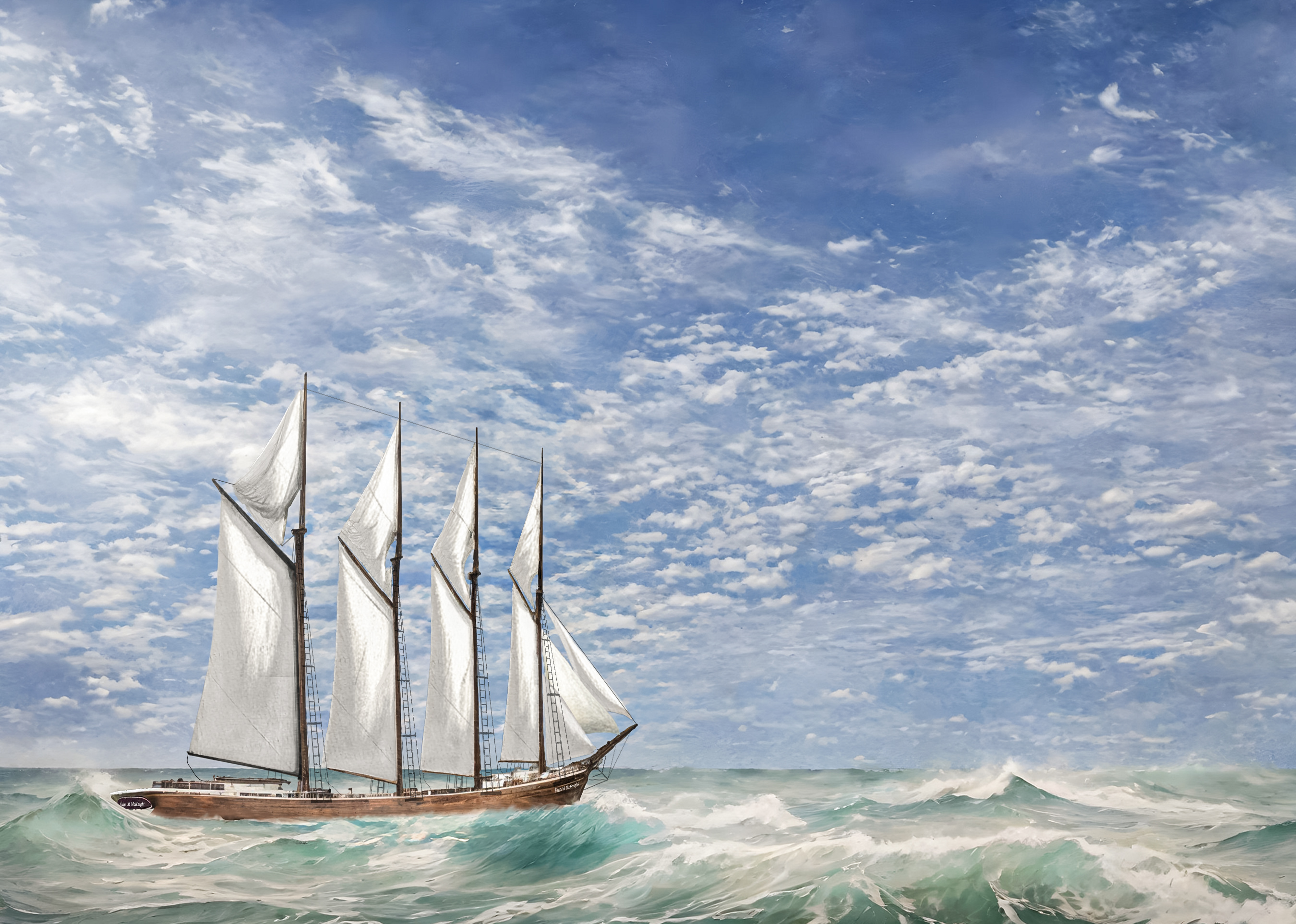
Flying Scud
In the mid-century turn toward the clipper, one perceives a kind of ornamental acceleration—a sharpening of the line, a tightening of the sail plan, all in service of shaving days rather than altering the fundamental calculus of maritime capacity. The clippers’ celebrated passages, while rhetorically inflated as proofs of a new order, in fact constituted only heightened velocity without expanding the units that mattered to commerce. And because they offered no durable answer to the encroaching logic of steam and steel, the true engines of increase, they occupy a historical moment in which the persistent human drive toward increase diverted itself into refinement, flourish, and spectacle. What emerges is a technologically elaborate, economically fragile artifact: a vessel whose very elegance discloses a deeper pattern, namely that when the sustainability of increase is threatened, human ingenuity often migrates toward the aesthetic, producing forms that are impractical and transient because they refuse the demands of increase. We note this same pattern in the aesthetic aspects of the connected farm in New England (Hubka;1984 Big House, Little House, Back House, Barn), Stephen Jay Gould and Richard Lewontin’s biological "spandrel", and in various art movements (pointillism, fauvism, cubism, and abstract expressionism) as the camera chased painters away from representation.
Messrs. Howe & Co., New York.
Gentlemen: This will inform you of the ship Flying Scud's safe arrival at this port, after a passage of 75 days, all well. The ship was quite crank when we first left. The ship has made much better weather of it than I expected she would. She is a first-rate sea-boat, and as for her sailing qualities, I think she will go well. Second day from New York, in the Gulf Stream, shipped a sea; it took one man over the lee-rail, and about one quarter of our deck load. Was obliged to shorten sail to save the deck load of provisions. At 8 P. M. same evening, was struck with lightning; it knocked every one down that was on deck, but done the ship no injury. But, strange to say, it had a powerful effect on the compasses; they all going around like a whiz-buz for 12 hours. We have lost more miles by the compasses being out of the way than we have by the ship being out of trim, and both put together makes quite an item in our passage. The Flying Scud has made the quickest passage that has ever been made from the States to this port. We beat the ship Flying Dutchman seven days.
Gentlemen, I remain your obedient servant,
Captain W. H. Bearse Melbourne, January 8, 1855