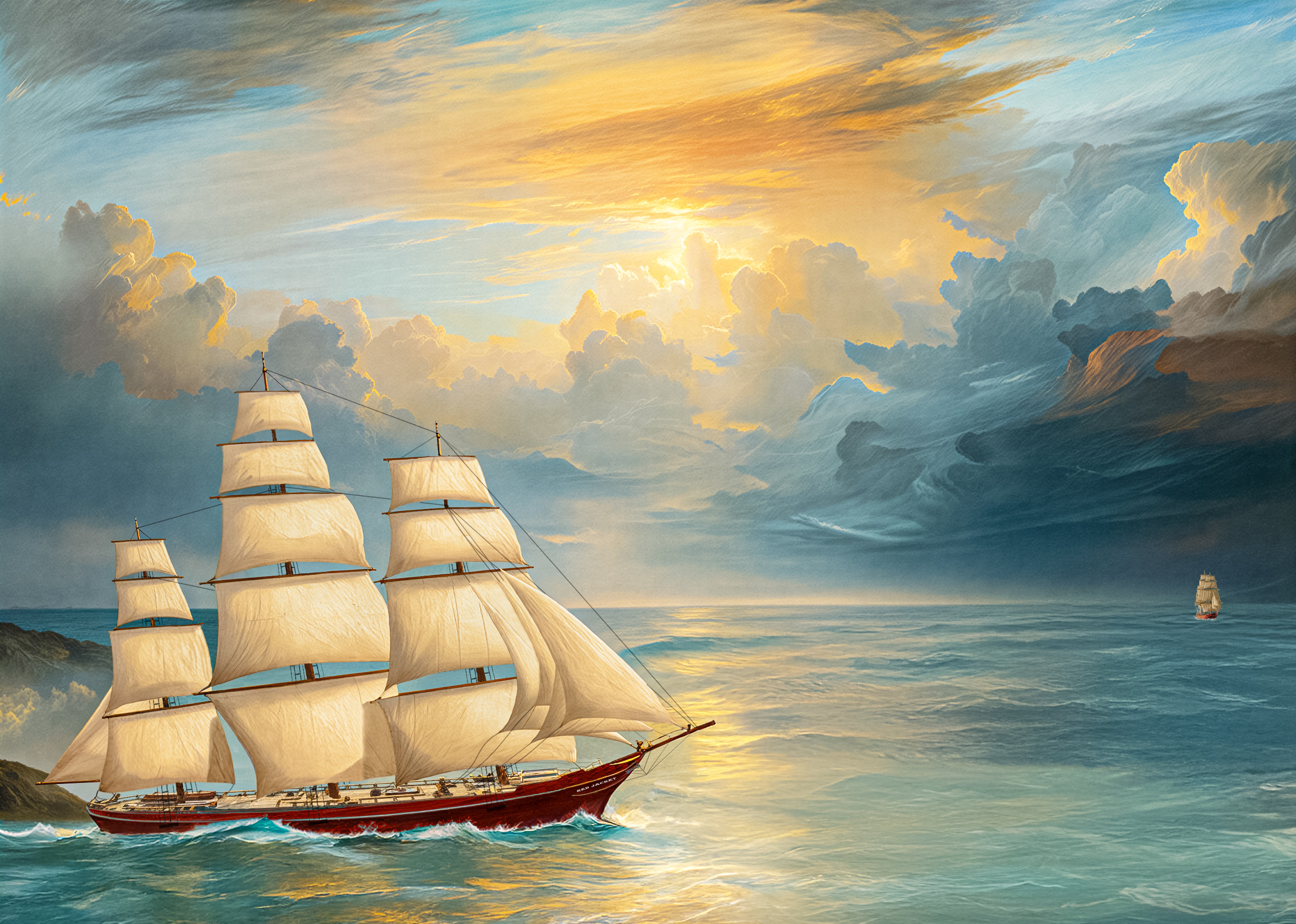
Wyoming
The largest and last of Maine’s six-masted schooners, the Wyoming embodied a grand ambition: to marry Maine shipwright mastery with Western confidence and money.
Wyoming is reportedly the only schooner built between 1879 and 1914 named for a state. The naming convention favored cities or individuals, most often women, while clipper ships were named by the phenomena they sought to embody: speed. The word Wyoming means "big plains," and the schooner Wyoming was the largest and last of the seven Percy & Small six-masted schooners. The schooner was named for a landlocked state because the Wyoming Governor had already claimed a namesake - the five-masted Governor Brooks built by the William T. Donnell shipyard under contract to Percy and Small and launched at Bath on October 22, 1907.
To navigate through the embroidered embellishments that cling to the schooner Wyoming (look to the Great Lakes to find more stoutly built and larger wooden schooners) we have an Archimedean point in the form of the Memoirs of Bryant B. Brooks. The Wyoming Governor came to be invested in the Percy & Small fleet by way of his older brother, a Massachusetts resident whose proximity to maritime capital opened the channel.
Brooks was a staunch believer in increase (perhaps a drive shaped by the horror vacui of the Wyoming landscape) which manifested itself in a political ethos grounded in the “greater good.” In his autobiography he recounts Percy & Small’s solicitation for Western Capital resulting in the building of the five-masted schooner, Governor Brooks, a vessel he described as: the symbol of a handclasp of East and West, in mutual sympathy on maritime problems. The problems were a lack of national cooperation between regions over federal regulation. Specifically, excessive federal ownership of Western lands and foreign competition undermining Eastern maritime interests.
Brooks’s commitment to increase took the form of sustainability rather than speculation, a philosophy that clashed with the maritime industry's inherent risks. He questioned Captain Percy about the necessity of insurance and Percy’s reply was likely unsettling: “I have been investing in vessels all of my life but have never carried any insurance unless I had a very large interest, and then only partially.”
Brook’s memoir speaks of the Governor Brooks initial investment being returned by 1916 through dividends. The only increase came from capital gains when Percy & Small sold the fleet in 1917 during the asset bubble caused by World War I. Taken together, his business ventures - oil, banking, lumber, mining - produced subpar returns. Sustainable increase arose instead from consolidating central Wyoming ranches under the B. B. Brooks and Company brand. The focus was the raising of sheep and cattle across the Stroud Ranch, the Banner Ranch, the Buzzard Ranch, and the C-Lazy-Y Ranch.
Today, the Governor’s great-great-great grandson has subdivided the 33,000-acre B. B. Brooks Ranch into forty-acre parcels, offered at sixty to one hundred thousand dollars. The raw land is set in grassy rolling hills facing Casper Mountain. It represents the alternative to sustainable increase: speculation that, if enough people buy in, there will be increase.
Today, the Governor’s great-great-great grandson has subdivided the 33,000-acre B. B. Brooks Ranch into forty-acre parcels, offered at sixty to one hundred thousand dollars. The raw land is set in grassy rolling hills facing Casper Mountain. It represents the alternative to sustainable increase: speculation that, if enough people buy in, there will be increase.