Edna Hoyt
In the epilogue to Crowds and Power (1960), within the section titled “The End of the Survivor,” Elias Canetti identifies a fundamental shift in the modern era. He writes:
"In modern industrial production the ancient substance of increase has undergone such a colossal expansion that, compared with it, all the other elements of life seem to be on the wane. Terrible wars have not halted it and, whatever the nature of the various opposing camps, it is rampant in all of them. If there is now one faith, it is faith in production, the modern frenzy of increase; and all the peoples of the world are succumbing to it one after the other."
By the end of the 19th century, this "frenzy of increase" had manifested physically in the shipping industry. The “fine lines” once associated with maritime grace were sacrificed for sheer cargo capacity. Eventually the vessels revolted against these ever-increasing demands and the massive hulls began ‘snaking’ or ‘hogging’ or they ‘took the bottom.’ Tug Captain Charles A. Drew famously observed that these massive vessels appeared to be "built of hoop poles and caulked with eel grass — limber as a snake."
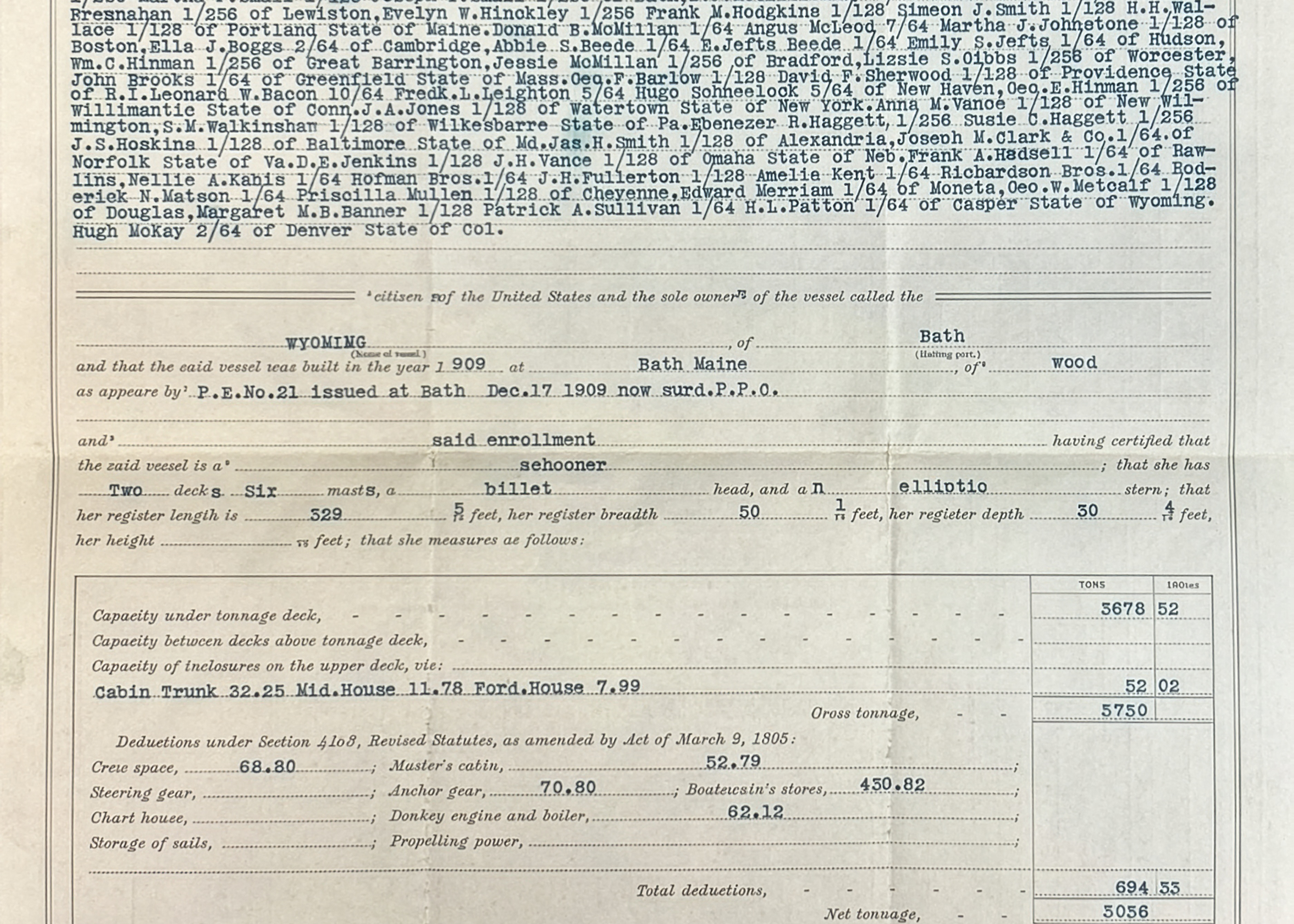
The schooner Jane Palmer, launched in East Boston in 1904, served as a literal example of this phenomenon; her forward deckhouse was said to rise and fall dramatically whenever her bow mounted a wall of water. She represented the zenith of this trend toward massive dimensions. Originally intended as a six-master, the hull was purchased by William F. Palmer for a pittance and converted into a five-master. She became the largest of her kind: 3,138 gross tons, 308 feet in length, with a 49-foot beam and a depth of 22 feet.
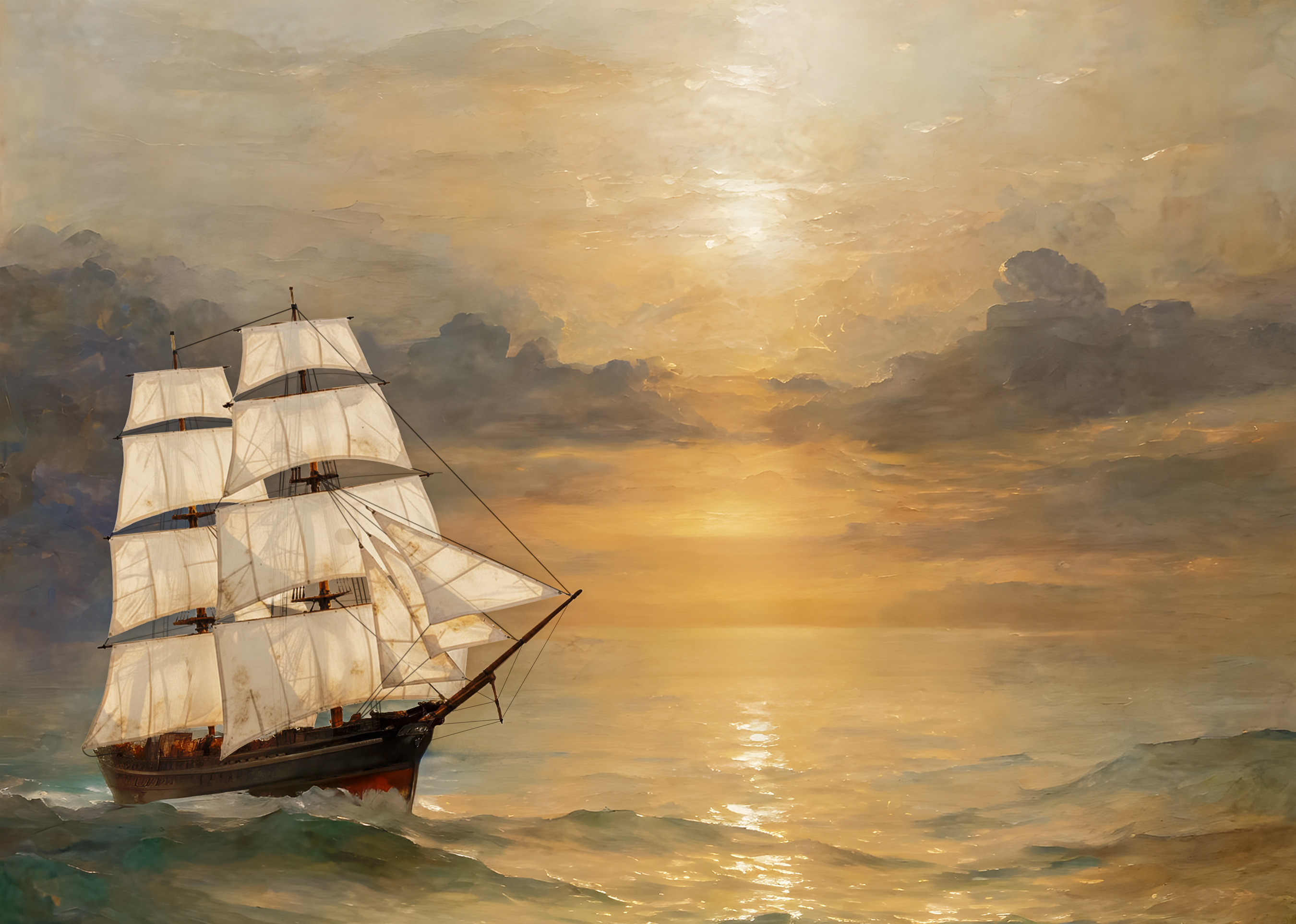
After the Jane Palmer schooners of this rig began to be pared down. This era concluded with the Edna Hoyt. Following the launch of the Mary H. Diebold on November 27, 1920, the Edna Hoyt was launched two weeks later, on December 11. Built at the staggering cost of $280,000 and named for the wife of a key investor, she was the last of the 52 Maine-built five-masters. Notably, she was also the second smallest, registering at only 1,512 gross tons and 294 feet in length—roughly half the tonnage of the massive Jane Palmer.
As the last of her line, the Edna Hoyt became a living lament, drawing crowds at every port of call to pay their respects. It was as if this schooner possessed an internal perfecting principle - an entelechy - or perhaps the public simply came to witness the indomitable soul of a survivor. Ultimately, the will to increase and the will to survive are inextricable, each shaping the material expressions through which an era understands itself.